
BY JOHN-ALEX OLIVIA.
How farming, food, tradition and community life meet in Abam, Ubakala
A community feature
The first thing the photograph reveals is abundance. Hundreds of cassava tubers lie in a heap beneath a dense green canopy, their rough brown skins contrasting sharply with the leaves, vines and undergrowth around them. It looks like a simple harvest scene. But in Abam, Ubakala, a pile like this carries a much larger story — one about food, labour, land, family, tradition and the quiet resilience of rural life.
Abam is one of the communities in Ubakala, Umuahia South Local Government Area of Abia State. The community is made up of seven villages — Choko, Oma, Okwaike, Okwere, Onyema, Ihi and Okpaegbeamaocha. Its story cannot be separated from the land. Farming remains an important part of everyday life, and cassava stands at the centre of that agricultural landscape.
The community information gathered for this feature describes farming in Abam mainly as peasant farming: production is largely directed toward feeding families and meeting household needs, alongside petty trading. The rhythm of the farm is therefore also the rhythm of the household — what is planted, what survives, what is harvested and what eventually reaches the cooking pot or the market.
A FARMING CALENDAR WRITTEN INTO THE YEAR
In Abam, farming is not simply an activity that begins whenever a farmer enters the bush. It follows a recognisable seasonal pattern. Community information says farming activities are concentrated on Mondays, Wednesdays and Saturdays, a practice also linked to efforts to reduce the theft of cassava and other farm produce.
The agricultural year begins in March, when farmers clear their land and make ridges. April brings planting. Cassava is the major crop, but it does not stand alone. Plantain, banana, melon, yam, cocoyam and corn are also cultivated, while fruit trees and crops such as udara, pawpaw, soursop, pear, orange and guava add another layer to the landscape.
The harvest period runs from June into October. That timeline gives the cassava mound in the photograph a deeper meaning: it is not merely a pile of roots. It is the visible end of months of preparation, planting, waiting and work.
THE MAN BEHIND THE SACK
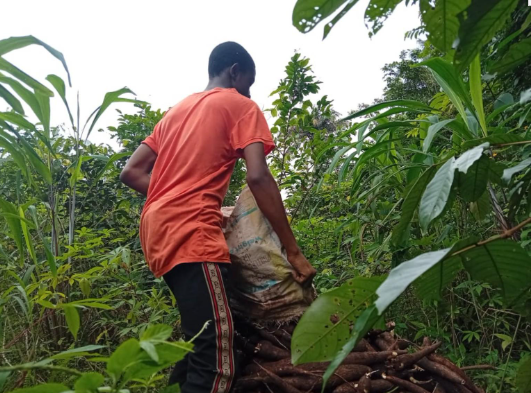
The second photograph changes the scale of the story. Instead of seeing only the harvest, we see a person moving it. A sack becomes a measure of effort. The cassava that looks almost anonymous when piled together suddenly has a human connection: someone entered the farm, worked the soil, gathered the roots and carried the harvest out.
This is important because agricultural stories can easily become stories about crops rather than people. Yet research from Abia State shows that cassava production involves substantial participation by both men and women. A 2019 study of 120 cassava farmers in Abia found women in its sample were more involved in cassava production activities than the men, illustrating that the crop’s story is also a household and gender story.
Other research in Abia has also documented the importance of cassava to food security and income among rural farming households, including research conducted specifically in Umuahia South Local Government Area.
WHY CASSAVA MATTERS BEYOND THE FARM
Cassava’s importance is not limited to the moment it is pulled from the ground. It can move through several stages — from farm to household, from household to processing, and from processing into food or trade. Research on cassava in Abia has examined its role in rural food security and household income, while other work has documented the use of cassava in products including gari, akpu, flakes and chips.
That makes the harvest an entry point into a larger question: what happens after the photograph is taken? How much of the crop is eaten at home? How much is sold? Who processes it? What transport is available? And what does a farmer earn after labour, inputs and transportation have been accounted for?
These are the questions that can turn a beautiful harvest photograph into a serious rural-economy story. Studies in Abia have identified issues such as input costs, access to land, extension services and transport infrastructure as factors affecting small-scale farmers.
LAND THAT RESTS, LAND THAT RETURNS
Abam’s farming system also contains a built-in relationship with time. Community information says farmers practise rotational farming: after a portion of farmland is used for a planting season, it is left unused for about four years before being cultivated again.
That detail offers another angle for the story. The land is not simply a production surface. It is something farmers work with over successive seasons. The period of rest raises questions about soil fertility, land pressure and how traditional farming knowledge can interact with modern agricultural practices.
At the same time, cocoa farming has recently joined the community’s agricultural activities, while palm trees remain part of the landscape and palm oil production remains another agricultural practice.
WHEN THE ROAD BECOMES PART OF THE HARVEST
A farmer can produce a good harvest and still face a difficult journey. In Abam, community information identifies erosion as a problem in some areas, particularly around the community slaughter area. During the rainy season, erosion can make movement difficult and create challenges for transporting farm produce toward urban areas.
This is one of the most important hidden parts of the cassava story. Production does not end when the tuber leaves the soil. If roads and routes are difficult, the distance between farm and market becomes more than a number on a map — it becomes time, labour, transport cost and risk.
Research on rural transportation in Abia has likewise examined the relationship between road conditions and cassava production, while studies of small-scale cassava farmers have identified poor road networks among the constraints affecting farmers.
THE HARVEST DOES NOT END THE COMMUNITY’S STORY
If farming explains how Abam feeds itself, culture explains how the community remembers itself. The community’s social life is marked by festivals that bring people together at different points in the year.
The New Yam Festival, usually celebrated in August or September, is tied directly to the harvest season. It is described as a period of thanksgiving for a successful harvest and is held at Ahia Afo, the community market square. The celebration includes traditional dances, wrestling, masquerade displays, food and village competitions.
The timing creates a striking connection: the farming calendar moves into harvest from June through October, while the New Yam Festival falls within that broader harvest period. Agriculture and culture therefore meet at the same point in the year — when the community has something to give thanks for.
FROM THE FARM TO THE TRADITIONAL STOOL
There is another thread running through Abam: community organisation. The traditional kingship operates on a rotational system among the seven villages. The stool moves from one village to another, beginning with Choko, regarded in the source material as the first son of Abam, and continuing through the other villages.
The system described in the community material requires a candidate presented by the village to be accepted by the community before the traditional process proceeds. After coronation, the king selects chiefs and can confer chieftaincy titles on people who have contributed to the growth and development of Abam.
The source identifies the present king as His Royal Highness Friday Ihioma Abam Ukwu II.
A COMMUNITY THAT RECONNECTS
The social calendar extends beyond harvest. Igba Ikoro, held during the Christmas and New Year period, brings together indigenes, in-laws, neighbours, friends and well-wishers, including people living abroad. The celebration gives those who have spent the year away an opportunity to return home and reconnect.
Seen this way, Abam’s story is not only about farming. It is about return — to the land, to food, to festivals and to community. The person carrying a sack out of the farm and the person returning home for a festival are part of the same larger story: a community continually renewing its connection to place.
THE NEXT CHAPTER: CAN TRADITION AND NEW AGRICULTURE MEET?
The future of Abam’s agriculture will likely depend on how well traditional knowledge and newer agricultural support can work together. Research in Abia has found relatively strong adoption of cassava agronomic practices among sampled farmers, while extension contact, farm size, education and other factors have been associated with adoption and efficiency.
More recent research in Abia has also examined climate-smart agricultural practices among cassava farmers, reflecting a wider concern about productivity under changing environmental conditions. citeturn0search2
For Abam, the practical questions are close to the ground: Can farmers get reliable planting materials? Can they access useful extension information? Can farm routes withstand the rainy season? Can more value be created from cassava before it leaves the community? And can the knowledge carried from one generation to another remain useful while new techniques are introduced?
THE PILE OF CASSAVA IS ONLY THE BEGINNING
Look again at the first photograph. The cassava mound is large, but the story around it is larger. There are the seven villages. There is the farming calendar. There are months of work. There is the household waiting for food. There is the farmer moving the harvest. There is the road that must carry it. There is the market. There are the festivals. There is the traditional institution that binds the villages together. And there is the question of what happens next.
That is what makes Abam’s cassava story worth following. It is not simply a story about a crop growing beneath a tropical canopy. It is a story about how a community turns land into food, food into livelihood, harvest into celebration and memory into continuity.
In the end, the most revealing image may not be the heap of cassava itself, but the human movement around it — hands that harvest, shoulders that carry, families that depend on it, communities that celebrate it and a new generation asking how the land can continue to sustain them.
REPORTING NOTE
This feature combines the three community-background documents supplied for the story with published research on cassava and smallholder agriculture in Abia State. Community-specific details are attributed to the supplied materials; broader agricultural context is identified through the cited research. No individual interview quotations have been invented. For publication, the story can be strengthened further with on-the-ground interviews with farmers, women involved in processing, traders, transporters, traditional leaders and agricultural extension personnel in Abam.
SUGGESTED PHOTO CAPTIONS
Photo 1: A large cassava harvest gathered beneath the green canopy in Abam, Ubakala.
Photo 2: A farmer carries a sack of harvested cassava from the farm in Abam, Ubakala.
SOURCE MATERIAL
- Community document: Farming Culture in Abam, Ubakala — supplied for this feature.
- Community document: Kingship in Abam Autonomous Community — supplied for this feature.
- Community document: Social Life of Abam in Ubakala Umuahia — supplied for this feature.
- Nwaobiala, Alozie & Anusiem (2019), Gender differentials in farmers’ involvement in cassava production activities in Abia State, Nigeria, Agrosearch.
- Apu & Oragwam, The Role of Cassava in Improving Rural Food Security and Income among Farmers in Abia State, Nigeria, Journal of Agricultural Extension.
- Nwaobiala (2018), Farmers’ Adoption of Cassava Agronomic Practices and Intercrop Technologies in Abia and Imo States, Journal of Agricultural Extension.
- Yisa et al. (2020), Gender Differentials in Technical Efficiency among Small-Scale Cassava Farmers in Abia State, Asian Journal of Agricultural Extension, Economics & Sociology.
- Obinna & Ukoha (2017), Comparative Effect of Rural Road Transportations on Cassava Production among Rural Farmers in Abia State, European Journal of Social Sciences Studies.
- Oparaojiaku et al. (recent study), Adoption of Climate Smart Agricultural Practices among Cassava Farmers in Abia State, Journal of Agricultural Extension.